
Choreographing the Wild: How Four Top British Garden Designers Use Plants
Jul 28, 2026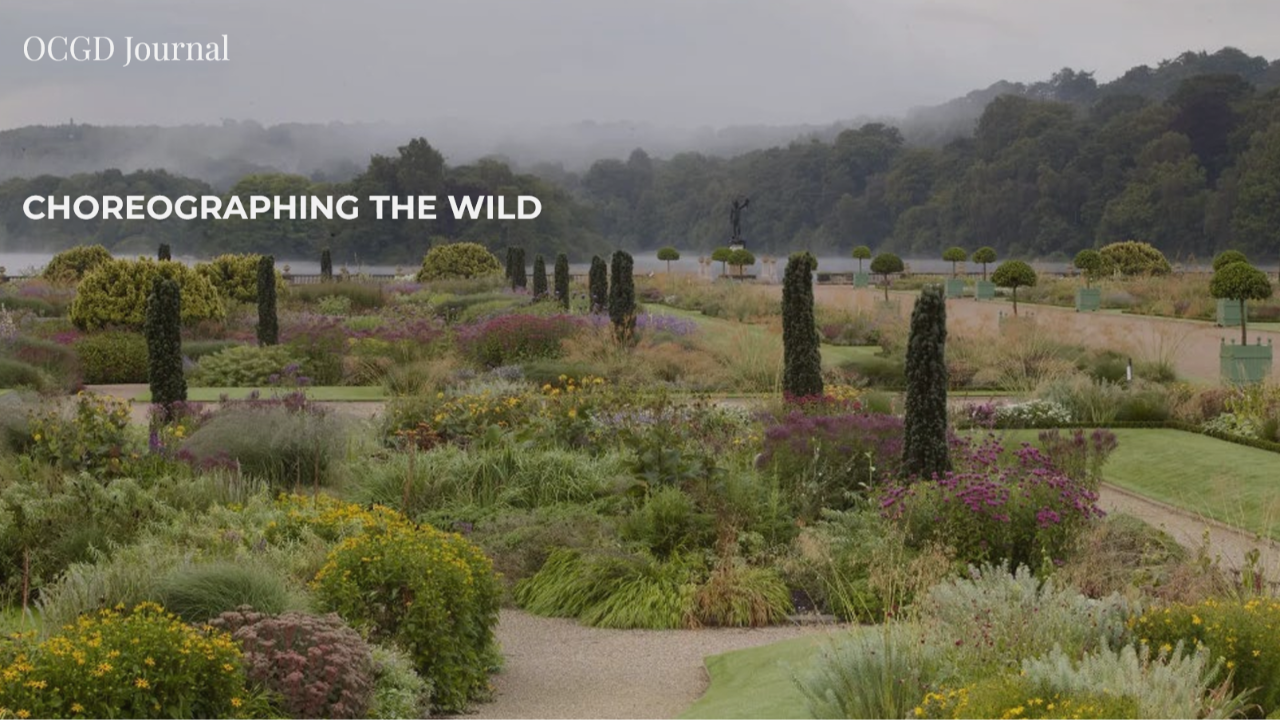
By Duncan Heather, Director of the Oxford College of Garden Design
Ask a group of amateur gardeners what makes a border beautiful, and most will talk about colour and variety. Ask a group of professional garden designers, and you'll hear something different: enclosure, restraint, geometry, story. That gap is worth understanding, because it's exactly the shift in thinking that separates a well-planted garden from a truly great one.
I've spent years studying how the very best British garden designers approach planting - not just what they plant, but why. Four names come up again and again: Tom Stuart-Smith, Dan Pearson, Anthony Paul and Arne Maynard. Look closely at their work and you find a set of ideas that run counter to conventional gardening wisdom. Here's what I've learned from them, and what any designer can take from it.
The Edge Experience: Why Boundaries Matter
Most gardeners assume an open view is always the goal. Tom Stuart-Smith often does the opposite.
He uses sharp demarcation - frequently clipped panels of hornbeam hedging - to create a deliberate boundary between the garden and the landscape beyond. By blocking the view rather than opening it, he sharpens the visitor's sense of what lies past the hedge. The enclosure doesn't shrink the space; it heightens the pull of the horizon.
As Stuart-Smith puts it: ‘An intrinsic part of English Gardening is the tension between enclosure, and the landscape beyond.’
It's a useful lesson for any designer: a boundary isn't a limitation. Used well, it's what gives scale and distance their meaning.
People-Like Shapes: The Psychology of Topiary
Stuart-Smith's borders are often ‘peopled’ - inhabited by free-standing topiary he describes as ‘people-like shapes.’ This isn't decorative whimsy. These forms act as a psychological anchor, giving the garden a permanent presence even when no one is there.
In winter, stripped back and stark, these clipped beech shapes read as ‘solitary soldiers.’ By summer, buried up to their shoulders in naturalistic planting at Broughton Grange, they seem to ‘party.’ The same static structure shifts character with the seasons - from sentinel to participant - which is exactly the point. Deceptive simplicity, done well, gives a garden rhythm across the year rather than just at its peak.
The Big Statement: Why Restraint Beats Variety
The most common mistake in planting design is trying to fit in too much - the ‘pretty flowering border’ packed with a dizzying range of species. Anthony Paul and Dan Pearson do the opposite. They champion what I'd call the Big Statement: large blocks of a single species, used for drama and architectural weight rather than variety.
In his Provençal work, Paul skips the obvious choice of Cupressus sempervirens in favour of gnarled live trees and cairn-like stone turrets, which give a new garden instant scale and a sense of age.
This kind of massing forces you to look past colour and notice texture. Persicaria polymorpha is a good example - a giant plant whose cream plumes fade to what Paul calls ‘milky tea.’ Paired with the verticality of Miscanthus or the wiry gold of Stipa gigantea, these bold groupings turn a flower bed into something closer to sculpture.
Reading the Landscape
Dan Pearson, whose training was in the arts rather than horticulture, describes a successful garden as ‘storytelling with very few props.’ That means reading a site before you plant it - noticing how light falls on a landform, or how a dry-stone wall offers shelter from the wind.
For Pearson, a garden's success isn't measured by visual complexity but by the ‘sense of calm and well-being’ it creates. A seat placed in a clearing, or a dip sculpted into a hedge-line, is enough to slow someone down. As he puts it: ‘Gardens are a very important link between man and the environment. In the modern pace of life, they provide an opportunity for fantasy and escape.’
Architecture as an Antique Jewel
Arne Maynard specialises in what I'd call the ‘urban jewel’ - small, intense spaces that sit comfortably within the formal framework of a grand English house. His architectural training shows in how he handles daunting urban walls, softening them with ‘green veils’ of foliage without losing the strength of the lines beneath.
Both Maynard and Stuart-Smith are experimental gardeners in their own plots, and I think that's not a coincidence. Testing ideas at home gives them the confidence to execute ambitious, complex schemes for clients. It's also what lets them avoid what Stuart-Smith calls the ‘dreadful inevitability’ of simple symmetry, instead offering multiple routes through a space so each visitor experiences it differently.
Hidden Geometry: Where the Structure Comes From
Look closely at these gardens and you'll often find a hidden logic borrowed from somewhere else entirely. Stuart-Smith studied Zoology at Cambridge, and the box parterre at Broughton Grange is based on a pattern taken from the microscopic cell structure of oak, ash and beech leaves. That biological underpinning is part of why the design feels so connected to the countryside around it, even though most visitors would never guess where the pattern came from.
Anthony Paul works from a different discipline. He treats the ground as a ‘giant flat canvas,’ using water rills and tessellating blocks of colour - diagonal rows of lavender and bearded iris, for example - to build an abstract composition. It looks simple. It isn't. It depends on a precise understanding of positive and negative space, and on marrying the hard edge of cut stone with the movement of planting.
Conclusion
None of this is about imposing order on nature. A garden, as Stuart-Smith says, ‘emphasises the processes of growth and death’ - it's a living process, not a finished object. What connects Stuart-Smith, Pearson, Paul and Maynard is a willingness to work with that fact rather than against it: through the layers of control between what's planted and what's wild, through big blocks of restraint rather than variety, through structure borrowed from biology or art.
If your garden were a story, what would the landscape tell you to write?
Key Takeaway
The best planting design rarely starts with ‘what looks nice together.’ It starts with a decision about structure - where to create tension, where to hold back, where to borrow a pattern from something entirely unrelated to horticulture. Get that decision right, and the planting almost designs itself.
