
The Garden That Was a Painting
Jul 29, 2026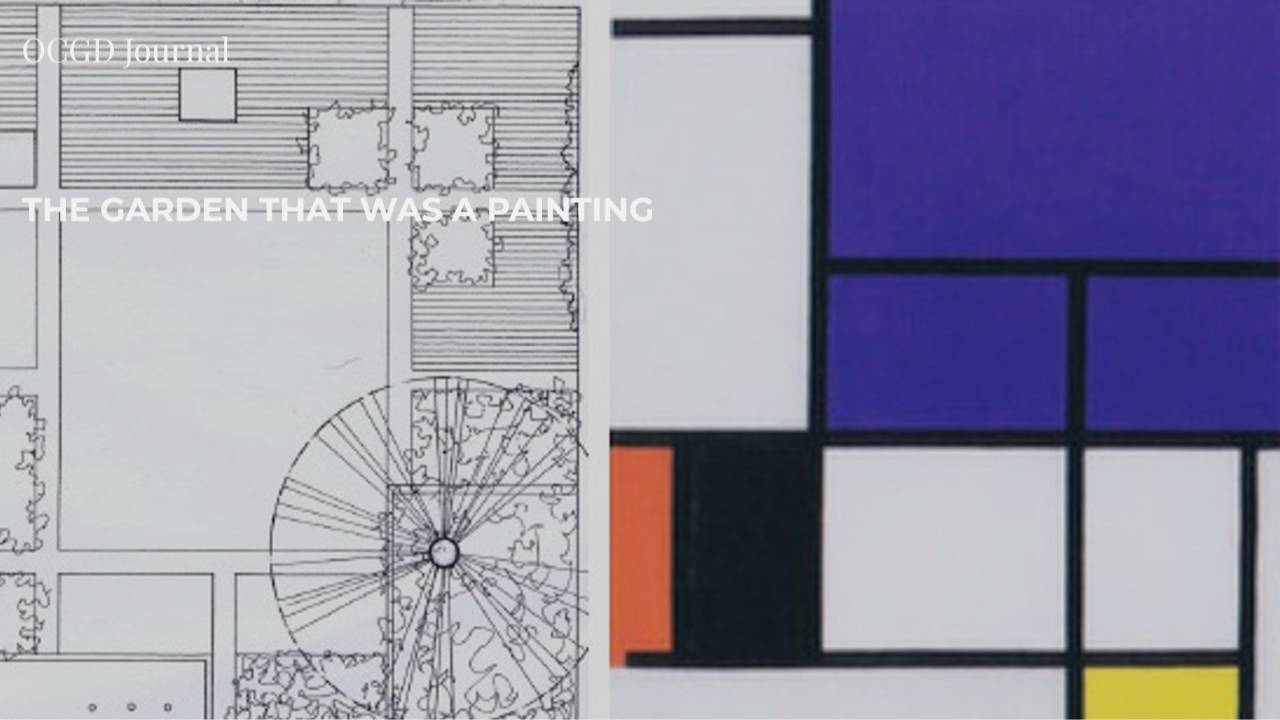
By Duncan Heather, Director of Oxford College of Garden Design
In the 1970s, a design studio near Heathrow was commissioned to build a courtyard for the offices of Penguin Books. The brief was straightforward: a modern space, for a modern building.
What the designer produced was something else entirely. He took a painting - a Mondrian, one of those compositions of coloured blocks and black dividing lines that most of us recognise even if we couldn't name the artist - and he laid it on the ground.
Not as a print, or a mural. As a garden.
Where Mondrian had used four blocks of colour, the designer used four materials: paving, planting, water, and lawn. The proportions held. The lines held. Stand above that courtyard and you'd see the same composition as the painting - except one was oil on canvas, and the other was alive.
The designer was John Brookes, arguably the most influential garden designer of the twentieth century - not just in Britain, but internationally. He wrote dozens of books that still line the shelves of anyone serious about the profession, and he trained a small number of designers directly, one of whom is Duncan Heather, now Course Director here at OCGD.
We tell this story often, because it answers a question better than any prospectus page can: what actually is garden design?
Design Breakdown: Two Ways of Seeing a Garden
John Brookes called his method pattern analysis - and it comes from the same part of the brain that responds to art rather than arithmetic. You look at a space the way you'd look at a canvas: as shapes, proportion, and rhythm, before you look at it as a list of things to fit in.
This sits in contrast to the method taught in most design schools and universities, known as survey analysis design. Here, you begin by breaking the garden down into its component needs - a "shed" bubble, a "lawn" bubble, a "patio" bubble, a "pond" bubble - and then you experiment with how those bubbles relate to one another in space. It's how architects plan a house: a kitchen bubble beside a dining room bubble, a hallway connecting them.
Neither approach is more correct than the other. Most people lean naturally towards one - a more intuitive, right-brain response to pattern, or a more analytical, left-brain approach to function. The strongest designers can do both, because a garden has to satisfy both instincts at once: it has to work, and it has to look right.
This is also where a common worry can be put gently to rest. We're often asked whether you need deep botanical knowledge to train as a designer. You don't - not in the way people assume. In professional practice, most designers draw on a working palette of perhaps 150 to 200 plants, used the way a painter uses a palette of colours: for form, mass, and texture, in service of a composition. Understanding soil science and plant biology is a genuine asset, and anyone without a horticultural background can build that separately, at a fraction of the time and cost, through a course like the RHS's. But it is not, in itself, what makes a garden design succeed.
What makes a garden design succeed is the same thing that made a Mondrian painting succeed on a stretch of ground outside Heathrow: knowing how to compose a space.
From Duncan's Desk
I still think about that Penguin Books courtyard more than almost anything else from my early career. Not because it was clever - although it was - but because it proved something. It proved that a garden could hold its own next to a painting hanging in a gallery. That it wasn't a lesser art form. That the discipline of composing space with paving and planting and water deserved to be taken exactly as seriously as composing a canvas with paint.
That belief is still the whole foundation of how we teach at OCGD. We're not, first and foremost, a horticultural course. We're a design course - one that happens to use plants, alongside stone, water, light and structure, as its materials.
If you've ever looked at a garden and felt something shift, the way you might in front of a painting, you already understand more about this profession than you think you do.
A Straightforward Next Step
If this way of thinking about gardens interests you, our Diploma teaches both pattern analysis and survey analysis design in full - alongside the technical, business, and professional skills that turn a design philosophy into a practising career.
We'd encourage you to see it for yourself before deciding anything. Join one of our live Q&A sessions, where you can ask Duncan and the team anything about the course, the industry, or whether this is the right route for you.
