
Right Garden, Right Place: 7 Counter-Intuitive Truths for Designing a Garden That Actually Belongs
Aug 11, 2026
by Duncan Heather, Director of Oxford College of Garden Design
Understanding Genius Loci: The Spirit of Place in Garden Design
You may have heard the saying: right plant, right place. But what about right garden, right place?
It's an easy trap to fall into: treating the garden as an afterthought once the house is finished - a rectangle of lawn, framed by a few flower beds and a stretch of paving that never quite feels intentional. These spaces can feel empty because they lack what Alexander Pope, in 1731, termed Genius Loci: the "Spirit of Place." To create a garden that is more than a collection of plants, we need to look past horticulture and toward an architectural philosophy that treats the landscape as a three-dimensional composition.
As Elizabeth Kassler, the former curator of the Museum of Modern Art, observed: "even a formal urban plaza or a single building can be informed by the spirit of its place. A garden must belong to its landscape, rather than merely occupying it." To achieve this, we need to look beyond the common myths of gardening and embrace the realities of professional design.
In urban landscapes, this is harder to achieve, as the garden is often surrounded by other similar houses and comparable plots - so inspiration tends to come from the client rather than the building or its surrounds. With country gardens, however, the spirit of place comes into its own, and a garden that links both building and landscape will outlast many generations of homeowners, simply because it feels right.
1. Stop Designing from the Fence Inward (The "Base Shape" Rule)
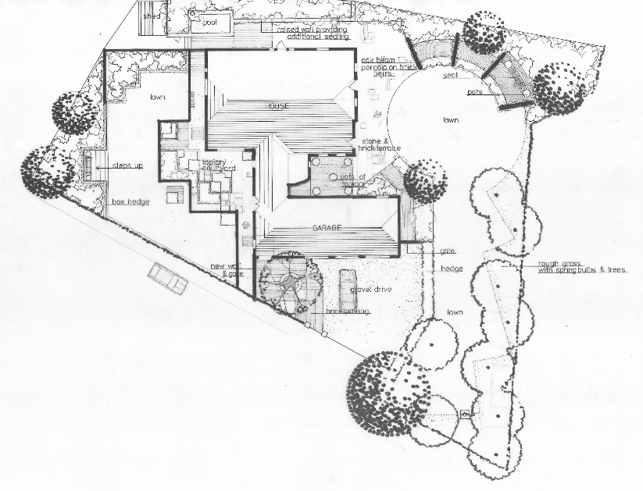
One of the most common mistakes in garden design is starting at the boundary and working inward toward the house. In truth, every successful design starts from the building outward. The house is the most dominant element of the site, so the garden should take its cues from the building's proportions and materials.
On our online garden design diploma course, we stress the importance of the building as the "base-shape" of the entire scheme. The terrace acts as the link between the architectural environment of the home and the biological habitat of the garden - it isn't merely a place to sit; it's the anchor that dictates the placement of every subsequent shape on the plan. As soon as a mark goes on the page, it influences everything that follows. Get this foundation wrong, and the rest of the garden will never "hang together." Designers should also resist the urge to build "helicopter pads" - terraces so disproportionately large that they fail to achieve a human scale.
"Horticultural excellence in the garden can never compensate for a fundamentally bad layout." Thomas Church, landscape architect
2. The Grid Is Not a Cage; It's a Skeleton
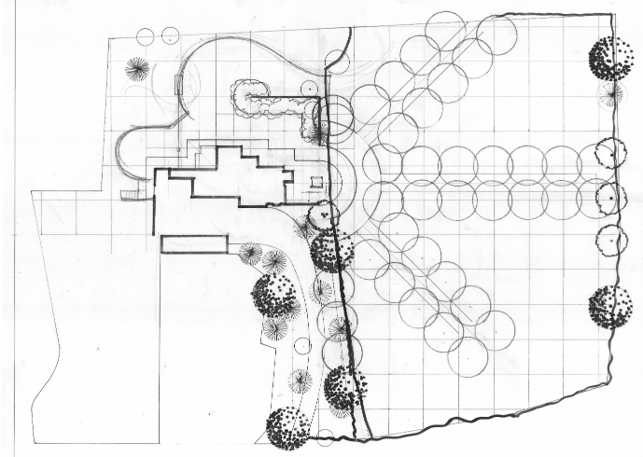
It's a common misconception that a rigid geometric grid restricts creativity. In reality, the grid is what provides the freedom to organise space in a way that feels instinctively correct. By taking "desire lines" from the centre of doors and windows and projecting them into the landscape, you create a subliminal sense of comfort.
This grid ensures that the "undecorated rooms" of the garden relate back to the scale of the interior living spaces. Psychology tells us that an undecorated room is an unused room; when the outside space mirrors the proportions of the house, the brain responds to that uniformity, and the space starts to feel usable rather than empty.
"The grid is the skeleton of the imagination." Jonathan Glancey, architectural critic
3. Beware the "Large Intestine" (The Myth of the Organic Curve)
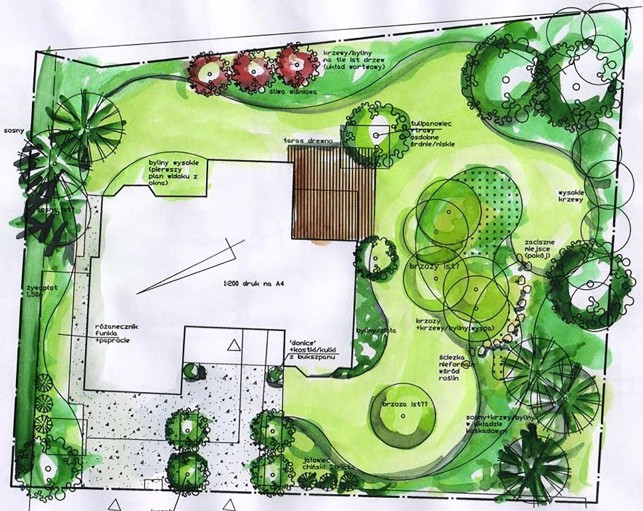
Many self-designed gardens fall into what professionals nickname the "Large Intestine" effect -wiggling paths and wavy borders that curve for the sake of curving, without leading anywhere or serving a purpose. The house looking like it’s just landed from space and the garden looking like a giant amoeba doing its best to digest it.
While masters like John Brookes and Roberto Burle Marx used "curvilinear" design brilliantly, their curves were never random - they were purposeful, mathematically derived from interlocking circles.
Humans have an innate need to impose order on their surroundings. What looks beautiful in a vast, wild mountain range - the "Natural Unity" of a rural landscape - can read as unhappy chaos when shrunk to a domestic scale. Simple design is notoriously hard to achieve, but human-imposed geometry is far more pleasing to the eye than "organic" lines that fail to respect the home's footprint.
4. Engineering the Speed of the Soul
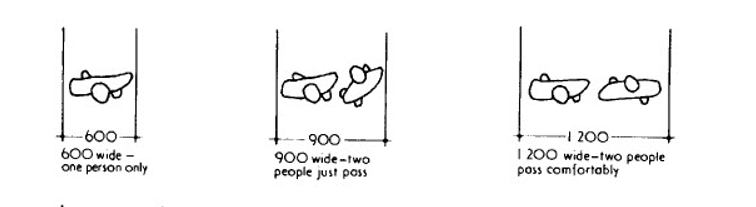
A designer can shape exactly how a person experiences a space by manipulating the physical and visual "speed" of the journey - the engineering of pace through material choice and rhythm:
- Narrow paths: suggest purpose and speed, drawing the visitor toward a destination.
- Wide paths: suggest lingering and "visual slowing," encouraging the observer to stop.
- Brick paving patterns: act as a subconscious speed bump, prompting a more hesitant pace.
- Cobbles and uneven textures: physically slow the gait, encouraging a more deliberate, contemplative walk.
The use of "rhythm and repetition" acts as the punctuation of the landscape. Repetition along a line of vision suggests progress, acting like commas in a sentence. Repetition across the line of vision, by contrast, acts as a full stop - halting the eye, and the soul.
5. What Your Client Really Wants From the Vegetable Garden
A designer's true job is to interpret what a client says they want alongside what they actually want. Clients, often motivated by aesthetics and the wish to make an impression, frequently ask for a substantial vegetable garden without fully weighing up the maintenance involved.
A standard 20m x 10m vegetable plot needs a commitment of at least one day a week from January through August - without it, the plot becomes an unruly jungle within months. As a rule of thumb, allow one gardening day a week for every one to two acres of garden. For the aspirational homeowner, the designer's solution is often to weave herbs and fruit - chives, mint, fruit trees -directly into the flower borders, satisfying the aesthetic urge without the maintenance burden of a dedicated plot.
6. "Borrow" the World (Turning Constraints Into Assets)
Good design understands that the garden doesn't end at the property line. In rural settings, we seek "Natural Unity" through the "borrowed landscape" - framing a distant view, like a church spire or a neighbouring tree canopy, so it becomes an integral part of the design. Rather than competing with such views, we cocoon the property so the wider landscape can speak for itself.
A constraint on a site is often the spark for genuinely ingenious design. Rather than fighting the land, work with it:
- Damp areas: instead of expensive drainage, create a lush bog garden.
- Cold north walls: use them to provide a cooling, textural contrast to sun-baked areas.
- Steep slopes: provide a strong, level "foundation" for a house on a hill, preventing the visual anxiety of a building that looks like it's sliding down the landscape.
7. The Tragedy of Homogenisation (Restoring Local Identity)
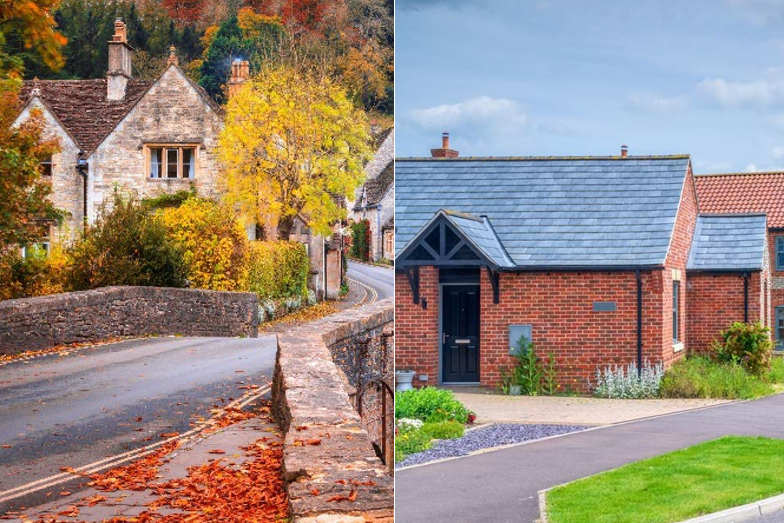
Modern development often suffers from a "blanket approach" - using identical materials nationwide and eroding regional identity in the process. We respond so positively to the Cotswolds because of the "introduced unity" created by local geology: the stone, the bridges and the paths all share a common DNA.
To create harmony rather than opposition, designers should prioritise indigenous plants and local stone. In urban contexts, where the backdrop of a natural landscape is absent, we need to "invent" a spirit of place - perhaps tying the garden to interior décor or the client's personality. The goal is to move away from the homogenised box and back toward a space that feels rooted in its specific soil.
Conclusion: The Seamless Link
Ultimately, professional design is characterised by simplicity and the rigorous philosophy that "less is more." A garden is not merely a collection of plants or a checklist of features; it is a three-dimensional composition built from the careful manipulation of levels, light and proportion - the seamless link between a building and its surroundings.
As you look at your own outdoor space, look beyond the roses and the grass and ask yourself: does your garden truly belong to its landscape, or is it merely occupying it?
Curious how these principles come together in a full design process? Download the Prospectus for the Oxford College of Garden Design's Diploma in Garden Design, and see how we teach the base-shape rule, the grid, and the rest of this thinking - step by step.
